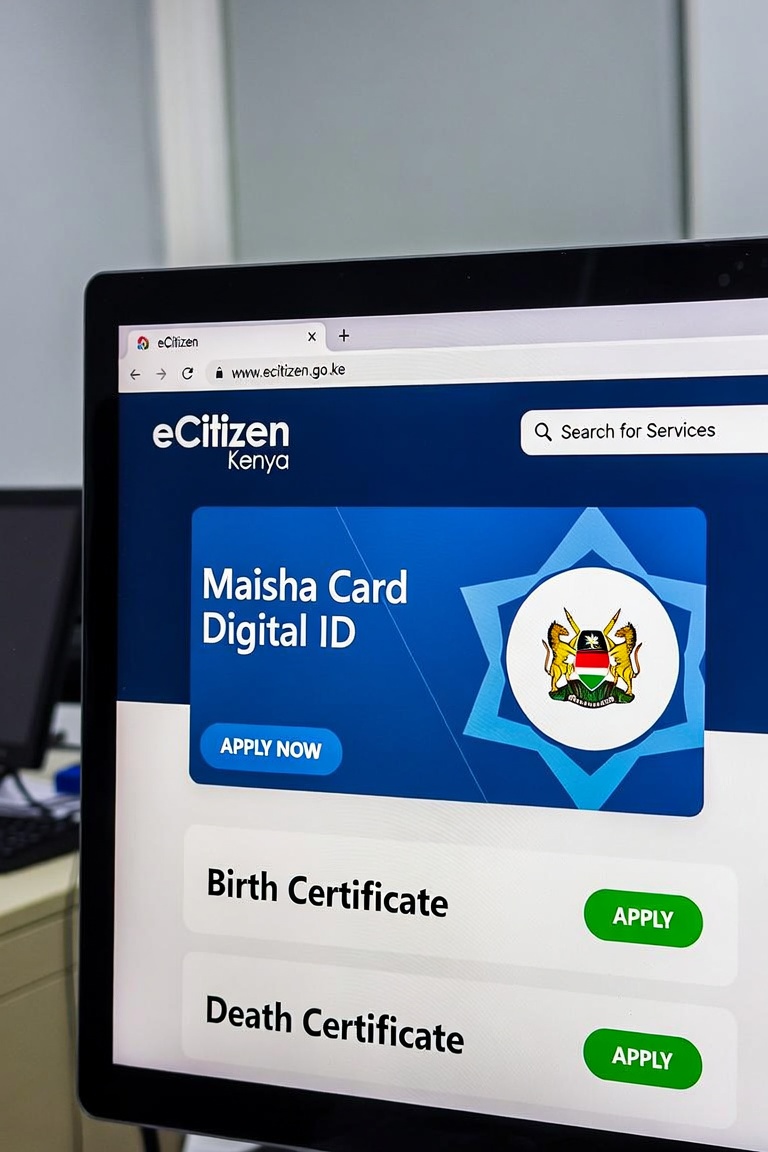
Maisha Card Digital ID + Birth & Death Certificates on eCitizen (2026 Guide)
Maisha Card Digital ID + Birth & Death Certificates Move Fully Onto eCitizen: What Every Kenyan Should Know in 2026
If you have ever taken a half-day off work, matatu'd into town, and stood in a slow-moving line just to collect a birth certificate you applied for weeks earlier — pole sana, those days are ending. As of June 2026, two of the biggest civil-registration changes in years have landed at the same time: your birth certificate can now be downloaded and printed from home, and the government has confirmed the Maisha Card is going digital, putting your national ID on your phone.
I have spent the better part of a decade helping Kenyans push applications through eCitizen, NTSA TIMS and iTax, so let me give you the plain-language version of what actually changed, what it means for your documents, and — honestly — where the new system still trips people up.
Quick answer (the TL;DR):
• Birth certificates: apply, get approval, and download + print the final certificate yourself — no mandatory trip to a Huduma Centre to collect.
• Cost: KSh 200 for a standard application; KSh 1,000 for amendments (excluding the eCitizen access charge).
• Maisha Card digital ID: announced and coming “soon” — a scannable, barcode-verified ID on your phone. No firm launch date yet.
• Maisha Namba: one 14-digit number from birth to death that links your ID, KRA PIN, SHA and more.
• Death certificates: civil-registration services are being pulled onto the same eCitizen rails too.
SHA Registration
We provide professional SHA registration services through the Social Health Authority portal. Expert...
So what exactly changed in 2026?
On 22 June 2026, after a consultative meeting at Nyayo House led by the State Department for Immigration and Citizen Services, Interior CS Kipchumba Murkomen announced that Kenyans can now download and print birth certificates online without travelling to a civil registry to collect them.
Here is why that is a genuine shift and not just a press-conference soundbite. Until now, eCitizen only let you start the process — you filled the form and paid online, but you still had to physically appear at a registry or Huduma Centre to pick up the printed document. The new system closes that last gap: application, approval, and the final download all happen online.
Days later, on 24–27 June 2026, the CS went a step further and confirmed that a digital Maisha Card is on the way. In his words, you will have your ID on your phone, with a barcode that can be scanned to confirm who you are — and even if you lose the physical card, the digital version on your phone still works. The government has not yet given a firm launch date, so treat “very soon” as exactly that.
If you want the bigger picture of how Kenya's e-government machine fits together, we broke it down in our guide to future trends in government services and technology adoption in Kenya.
One number from cradle to grave: how Maisha Namba ties it all together
To understand why birth certificates, death certificates and the Maisha Card are being discussed in the same breath, you have to understand the Maisha Namba — the engine underneath all of it.
Maisha Namba is a unique 14-digit personal identifier assigned at birth and kept for life. The clever (and slightly eerie) part is the lifecycle logic: that same number becomes your birth certificate number as a newborn, your national ID number at 18, and eventually your death certificate number. Along the way it is designed to fold in your KRA PIN, your SHA (formerly NHIF) registration, NSSF and your school records under NEMIS. The official National Registration Bureau FAQ lays out how these pieces connect.
So when the government talks about moving birth and death certificates “fully onto eCitizen,” it is really anchoring the two documents that bookend your life to a single digital identity. If you are curious how we got here — from the old black-and-white kipande to Huduma Namba to today's system — we tell that whole story in The Evolution of Kenyan IDs.
Birth certificates on eCitizen: then vs now
This is the change most families will feel immediately — especially in January when schools demand certificates for Form One and Grade One admissions.
| Before 2026 | Now (from June 2026) |
Application | Online via eCitizen | Online via eCitizen |
Approval | Online | Online |
Collection | In person at registry / Huduma Centre | Download & print from home |
Travel needed | Yes, often long distance | No, with internet access |
Standard fee | ~KSh 250 | KSh 200 (excl. eCitizen charge) |
Amendments | At the registry | KSh 1,000, processed online |
What you typically need on hand: the birth notification number (from the SMS/email or the printed Acknowledgment of Birth Notification given at the hospital or by your chief), an eCitizen account in the name of the parent, guardian or informant, the applicant's National ID, and a way to pay via M-Pesa. You apply through the official Civil Registration Services portal on eCitizen.
Sounds simple — and for a clean newborn registration, it usually is. The headaches start with the messy cases: a name that doesn't match across documents, a late or adult registration that needs affidavits and school records, a parent who is deceased, or an account that keeps throwing “ID number not recognised.” Those are exactly the applications that get rejected and quietly eat your KSh and your week. For the foundations of getting eCitizen itself working smoothly, our complete eCitizen guide is a good starting point — and when the case is not “clean,” that is the moment to let our team handle it for you rather than gamble on a re-submission.
KRA Pin Application for Kenyan Residents
We provide professional KRA PIN application services through iTax portal. Expert assistance with new...
Death certificates: the part people forget until it's urgent
Birth certificates get all the headlines, but death certificates are quietly moving onto the same digital rails — and they matter enormously at the worst possible time. A death certificate is what unlocks succession and inheritance, closing bank accounts, land transfers, insurance and pension claims, and SHA records. Under the Births and Deaths Registration Act, relatives of the deceased — and in some cases employers — can apply through Civil Registration Services on eCitizen.
There is also a cost angle worth watching. In January 2026, the CS announced the government is working to scrap application fees for both birth and death certificates and to house civil-registration offices inside constituency ID-registration centres so people stop travelling long distances for them. That is a stated direction, not yet a finished policy — so for now, plan as if the standard fees still apply.
In my experience, families navigating a bereavement should not be wrestling with portal errors and document uploads. This is one of the most common services we take off people's hands completely.
The Maisha Card on your phone: what we know (and what we don't)
Here is the honest state of play, because the internet is already full of half-truths.
What is confirmed: A digital Maisha Card is coming. It will let you verify your identity from your phone using a scannable barcode, and it is meant to act as a backup if your physical card is lost. You can read the CS's own words via Kenyans.co.ke's coverage of the announcement.
What is also true (and reassuring): Getting a Maisha Namba is voluntary, your current second-generation ID remains valid, and there is no mass re-registration like the Huduma Namba era. Most adults will simply transition when they next replace a lost, damaged or expired card. By 2026 the government had already cleared a backlog of over 600,000 cards and printed more than 1.7 million new Maisha Cards.
What we don't know yet: A firm rollout date, the exact app, or the registration steps for the digital version. Anyone promising you a guaranteed date is guessing. For independent analysis of the wins and the unresolved privacy questions, the IEA Kenya breakdown is worth your time.
The catch nobody at the podium mentions: the digital divide
Now for the part a Kenyan reader actually needs to hear. “Download it from home” assumes three things: reliable internet, a smartphone or computer, and the confidence to navigate a government portal that loves to time out during peak hours.
For a huge share of the country, at least one of those is missing. As People Daily reported, the risk is that services once available at a physical office quietly become inaccessible — not because you are ineligible, but because you lack the connectivity. Access to your own documents starts to depend on what they aptly called digital privilege. If connectivity is your bottleneck, our rundown of Kenya's internet landscape and providers can help you fix that side first.
This is also why public awareness matters so much during a transition like this — a point we explored in the role of public-awareness campaigns in government service delivery. A great reform that nobody understands is a reform that locks people out.
Where Cyber Mfukoni fits in
Here is my candid take after years of this work: the announcements are getting better, but the experience still rewards people who know the quirks. Name mismatches, rejected uploads, locked accounts, late registrations, deceased-parent cases, amendments, death certificates for succession, and diaspora applications from people who cannot just “pop into Huduma” — these are where time and money disappear.
That is precisely the gap we close. Rather than risk a rejected application, a wasted payment, or a document that schools or banks bounce back, you can hand the whole thing over and collect a clean, correct result. We also help you connect the dots between documents — for instance, getting your birth certificate and SHA registration aligned, which we cover in our guide to the Social Health Authority (SHA). If you are still weighing up whether to DIY or delegate, our piece on what online cyber services really mean for Kenyans makes the case better than I can here.
Ready to skip the trial-and-error? Order a service through Cyber Mfukoni and let our team handle the portal while you handle your life.
Frequently asked questions
Can I really download my birth certificate at home now?
Yes. Since June 2026, once your application is approved you can download and print the certificate from your eCitizen account — no mandatory collection trip. You still need internet access and a printer (or a nearby cyber café).
How much does a birth certificate cost on eCitizen?
A standard application is KSh 200, and amendment cases are KSh 1,000, excluding the eCitizen access charge. The government has signalled it may waive these fees, but that is not yet in force.
Is the digital Maisha Card mandatory?
No. Maisha Namba and the Maisha Card are voluntary, your second-generation ID stays valid, and there is no mass re-registration. Most people transition when replacing a lost or expired card.
What about death certificates — are they online too?
Civil-registration services, including death registration, run through eCitizen, and the government is pushing to migrate them fully. Because these documents are tied to succession, banking and land, accuracy matters — many families ask us to process them end-to-end.
Do I need a smartphone to benefit from any of this?
For the digital ID, eventually yes. For birth and death certificates, you need internet access — your own device, ours, or a cyber café. If connectivity is the barrier, that is exactly the kind of thing we sort out for clients.
Do I still ever need to visit a government office?
For standard birth certificates, increasingly no. For complex cases, vetting, or certain ID services, in-person steps can still apply — and our Huduma services guide explains when.
Kenya's documents are going fully digital — but “digital” only feels effortless when you know the system. If yours is anything but a textbook case, start your application with Cyber Mfukoni and let us get it right the first time.
About the author
Julius
IT & E-Government Services Specialist
Julius is a Nairobi-based IT specialist with over a decade of hands-on experience navigating Kenya's digital government platforms — eCitizen, NTSA TIMS, KRA iTax, and the Business Registration Service (BRS). He has helped thousands of individuals and businesses cut through the paperwork to access government services online and writes practical, step-by-step guides drawn from that day-to-day experience.
Related Agency
OTHER
OTHER
We provide professional online services for various government agencies and platforms including eCitizen services, document applications, online payments, and portal assistance. Trusted by Kenyans for fast, reliable, and affordable help with diverse government services.
View Agency ServicesRelated Services
Need Expert Assistance?
Our team can handle the entire application process for you.